
Aftersales revenue, like service readiness itself, is not the product of a set of separate activities. Robust aftersales revenue emerges from one connected and coherent flow.
In Part 1 of this series, Ralph considered service readiness as a business proposition.
In Part 2, he examined the role training plays in service readiness.
Now, in Part 3 of the Service Readiness Series, Ralph Pompea follows the aftersales revenue value chain. He explains how, by focusing on each aspect of aftersales—from diagnostics and parts to core return and branded accessories—OEMs create opportunities they never previously considered.
The Connected Service Workflow
Let’s say a correct diagnosis points to a specific service procedure. We’ll also assume the procedure calls for specific parts. Often, the parts you’re replacing carry a core that must be returned and remanufactured (reman).
When these steps share the same data, the technician is able to move easily from symptom to finished repair with no gaps, and the business recovers value at the end of the chain.
The chain runs in four linked stages:
- Diagnosis: Guided diagnostics isolates the true root cause, not just the symptom or a likely-looking code.
- Service procedure: the root cause maps to the correct OEM repair steps, with the warnings, cautions and relevant notes for the procedure in question.
- Parts catalog (EPC): By linking into the EPC, the process identifies the exact parts and quantities needed. This ensures correct parts ordering and reduces incorrect part returns.
- Core return and remanufacturing: the failed unit is captured as a core, returned and remanufactured. The OEM recovers material value and improves parts availability.
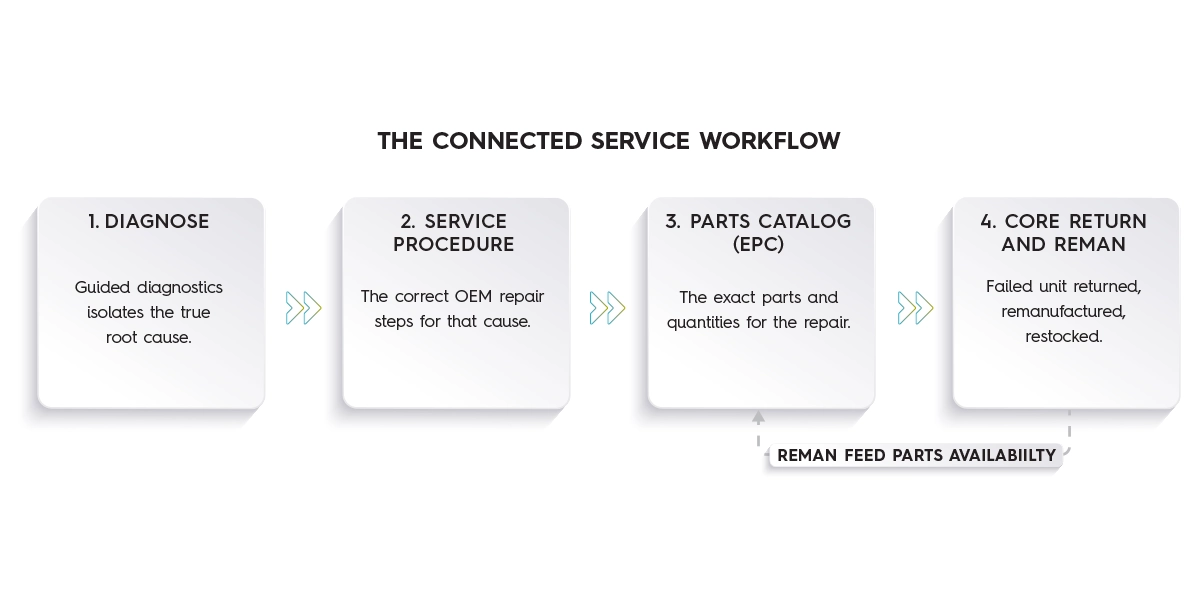
When diagnostics, service procedures and parts data share the same underlying content, each step passes clean, accurate data to the next:
- The diagnosis names the procedure
- The procedure names the parts
- The parts order identifies the core to be returned
The result is fewer wrong-part orders, faster repairs and a closed loop that turns a failed component into a remanufactured part, and additional aftersales revenue, rather than scrap.
Branded Accessories and Ownership in Aftersales Revenue
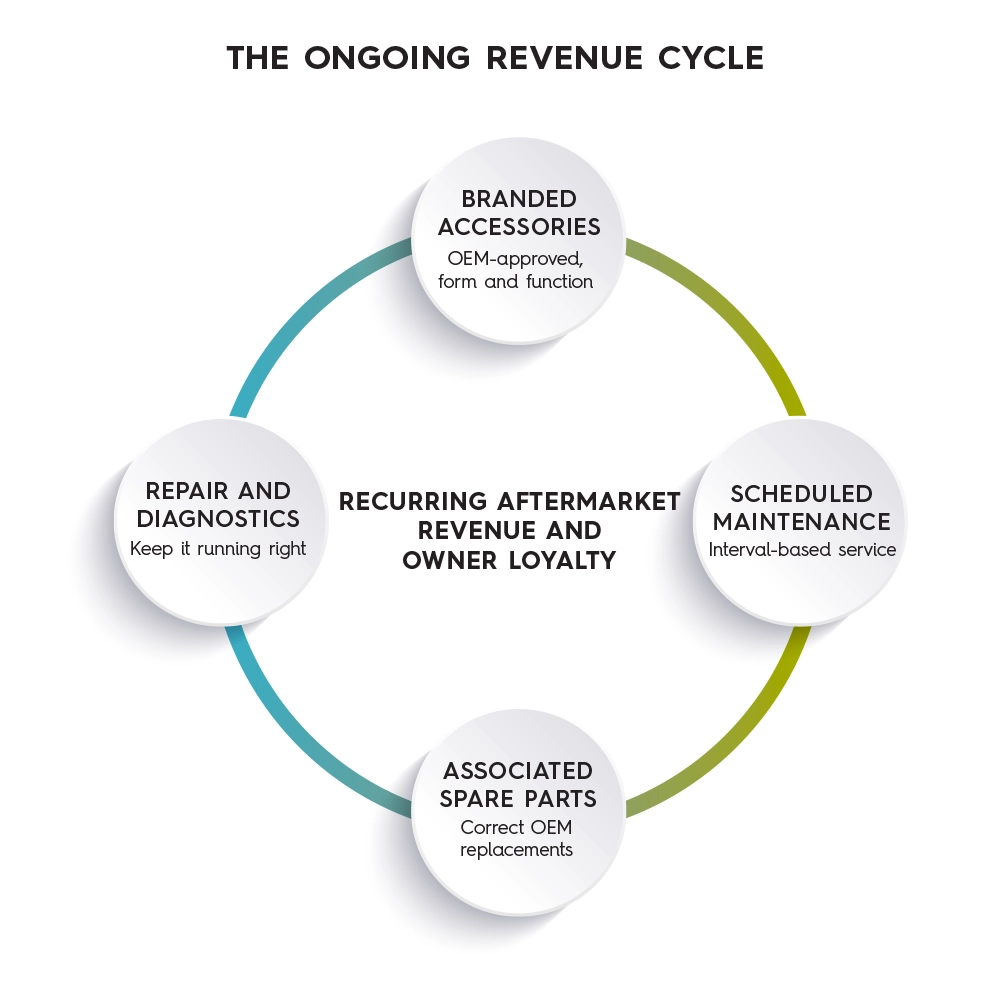
An OEM’s relationship with the owner of their product is an ongoing concern: it does not end at the sale. Branded accessories, regular maintenance and spare or replacement parts all form an ongoing revenue cycle that covers the entire life of the vehicle.
Service readiness protects this cycle and makes it stronger.
Branded accessories are OEM-approved companion pieces, engineered with form and function in mind to fit, perform, and last alongside the vehicle. Because they are designed and validated against the vehicle’s own specifications, they preserve fit and finish, protect the warranty, and respect safety and electronic systems such as ADAS sensors in a way generic parts often cannot. They extend the brand experience rather than dilute it.
Three recurring streams compound aftersales revenue over the ownership lifecycle:
- Branded accessories: Higher-margin personalization and capability add-ons designed to deepen an owner’s attachment to the brand.
- Scheduled maintenance: Predictable, interval-based service keeps the vehicle in the network and creates return visits for the owner.
- Associated spare parts: the correct, OEM-specified replacements identified and sold through the same service event.
Service readiness enables this cycle.
Correct accessory fitment instructions, the right tools, an accurate electronic parts catalog and trained technicians all ensure accessories and parts are chosen and installed correctly the first time. This helps capture aftersales revenue instead of losing it to generic alternatives or a poor fitment experience.
Guided diagnostics and the connected workflow tie the service event to the correct parts and accessories, and for electronically integrated accessories the SBOM and secure update process keep them compatible with the vehicle. Every maintenance visit and accessory sale provides a data point for the OEM and creates a buyer touchpoint that reinforces owner loyalty.
Battery Health Monitoring as an Aftersales Revenue Stream
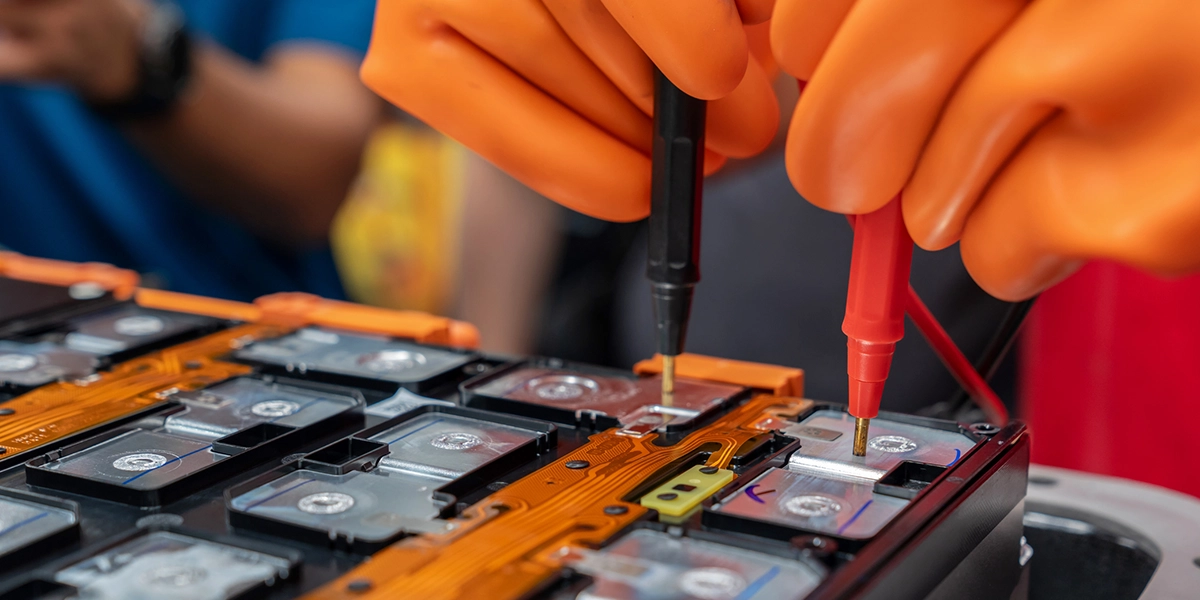
High-voltage batteries represent the highest-value component in an electric vehicle, and the largest single warranty exposure. But the health of the HV battery also represents an opportunity. Proactive battery health programs create two aftersales revenue streams at once: a fee for the health check itself, and, on healthy packs, a paid warranty extension. Both give the driver a safer vehicle and mitigate warranty risk for the OEM.
It’s a straightforward concept:
- Trigger the check mid-warranty: As the vehicle approaches the mid-way point of its battery warranty period, schedule a battery health evaluation.
- Charge for the inspection: The health check is a defined, OEM-priced service, delivered whether the pack passes or not.
- Produce a health report: Capture the battery’s state of health, usable capacity, degradation, cell balance and thermal and charge history.
- Offer a paid extension on a healthy result: If the battery passes, offer the owner a paid warranty extension.
- Set thresholds from internal data: Use the OEM’s own battery health and failure statistics to define pass thresholds and the extension pricing, so extensions are offered only where the data supports the risk.
- Act on a weak result: Packs below threshold are flagged for proactive service or closer monitoring, heading off a failure and a larger warranty claim.
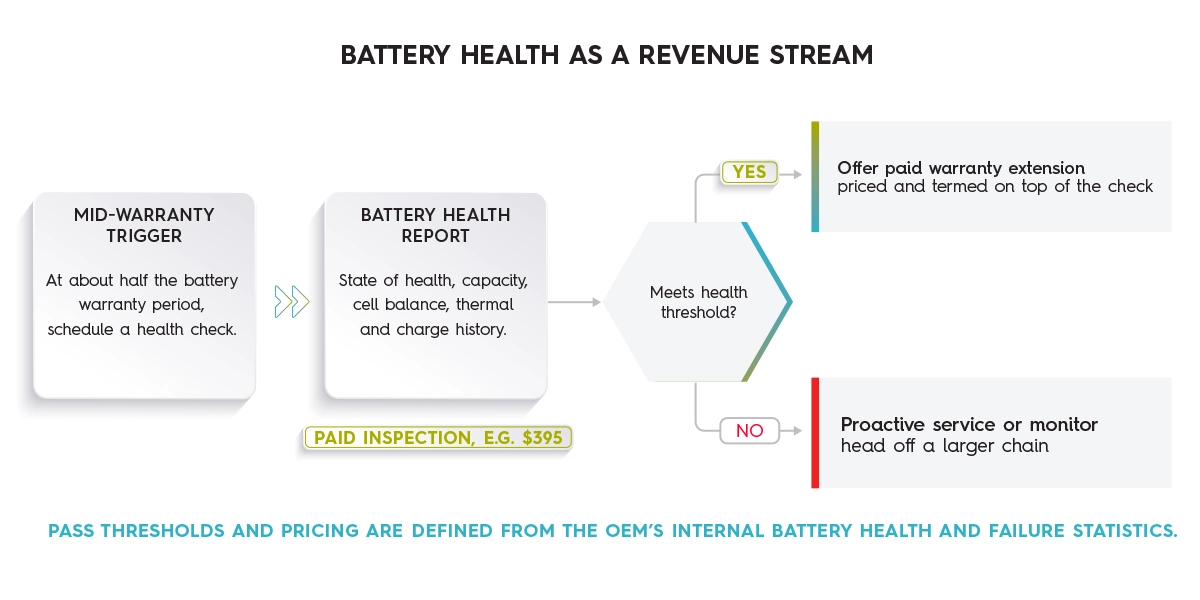
The owner experiences proactive, transparent battery care, which builds trust and keeps the vehicle in the network, and every health check feeds the service-data loop, sharpening the thresholds over time.
Service readiness makes the program dependable. Guided diagnostics produces a consistent, documented health report across every location. The right systems can use telematics to pre-screen the fleet and trigger the health check at the proper point in the lifecycle. Documented reports also strengthen genuine warranty claims and feed product-improvement programs.
The Owner-Facing Experience
Service readiness is usually framed around the technician, but the owner is the other half of the relationship, and arguably the most critical.
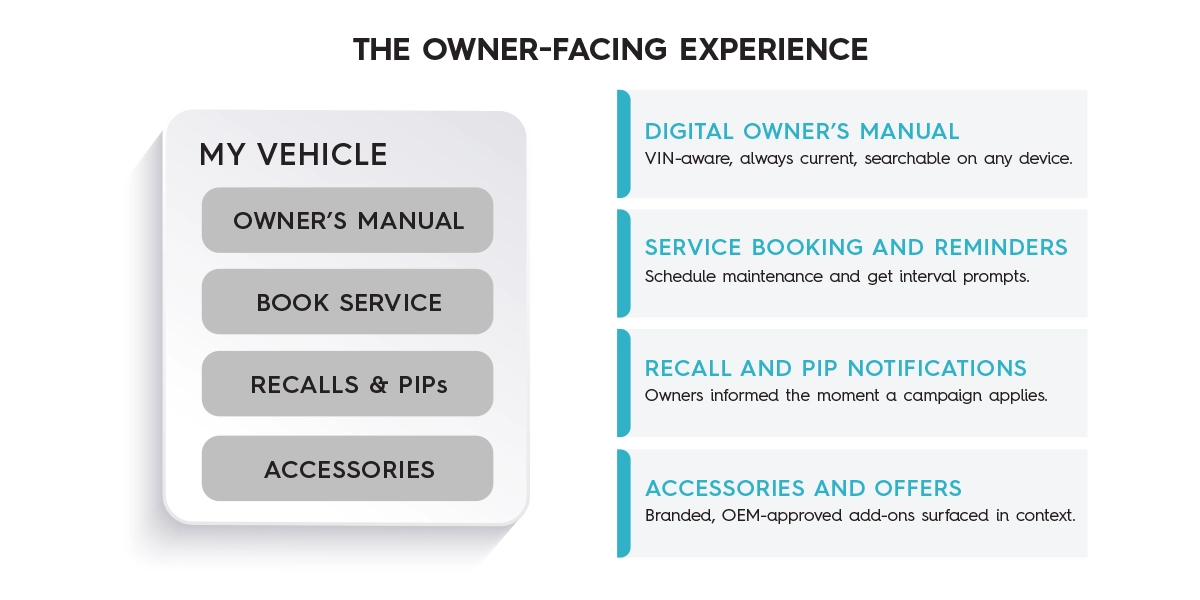
A connected, branded owner experience turns each vehicle into an ongoing relationship rather than a one-time sale, and it feeds the same aftersales revenue cycle accessories, maintenance, and parts depend on.
 A modern owner channel brings the vehicle and its service together in one place:
- Digital owner’s manual: VIN-aware, always current, and searchable on any device, replacing the glovebox binder.
- Service booking and reminders: Owners schedule maintenance and receive interval-based prompts, keeping the vehicle in the network.
- Recall and PIP notifications: Let owners know the moment a campaign or product improvement program applies to their vehicle.
- Accessories and offers in context: Branded, OEM-approved add-ons and maintenance offers surfaced to the right owner at the right time.
Delivered through a customer portal, this experience raises retention and satisfaction while generating demand for the very accessories, maintenance, and parts that make up the ownership aftersales revenue cycle.

It also closes the data loop from the owner side: booking, usage and notification data complement the service data captured in the bay.
This is where an effective Customer Portal completes the picture, giving the owner a branded, connected front door to everything the service organization does.
Next week, the series takes on The Software Defined Vehicle in Service Readiness, Part 4.