
Service Readiness is defined as “a service center’s ability to effectively handle vehicle maintenance and repairs. It requires having all the necessary tools, skills and processes on-site to efficiently satisfy customer needs and regulatory requirements in a comprehensive way. It should cover the full range vehicle technologies, from cutting edge to traditional.”
This series from Ralph Pompea looks at why Service Readiness matters to companies and their customers, with an eye toward what good Service Readiness looks like, the risks and economics involved, and where to start.
In Part 1, Ralph makes the executive business case for service readiness and provides a maturity self-assessment to help manufacturers determine their current-state baseline.
Overview: Why Service Readiness Matters
Service readiness is, quite simply, the ability to diagnose and repair a vehicle correctly on the first visit. When it happens, it means the right training, information, tools, software and parts were already in place before the vehicle arrived.
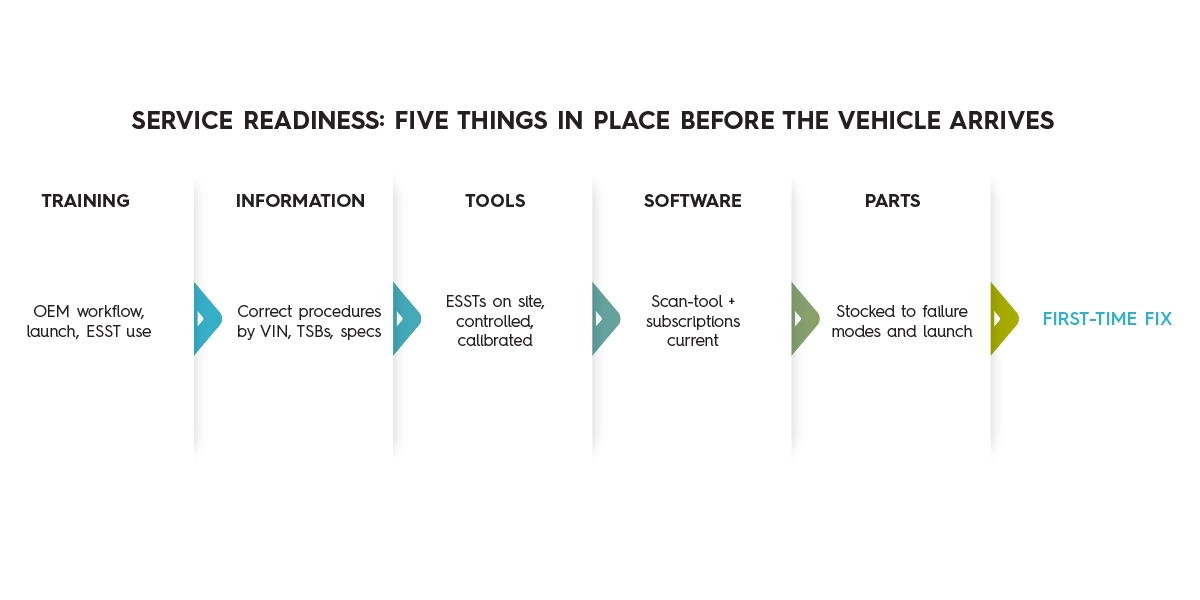
Why should leaders care about Service Readiness? Service readiness has a direct and demonstrable impact on fixed-operations profitability, customer retention and OEM compliance by reinforcing the following factors:
- Higher throughput (greater Repair Order or RO capacity): Faster diagnosis and fewer stalled jobs improves bay utilization and shortens appointment lead times
- Better FTFRs (First Time Fix Rates) and fewer comebacks: The correct tools and procedures help eliminate repeat visits and rework hours. Parts ordering becomes more efficient, too, as technicians no longer need to guess which parts should be ordered for a job
- Improved CSI and retention: Customers experience greater confidence in an outlet’s ability to repair thanks to faster turnaround times and fewer repeat issues
- Lower warranty and compliance risk: OEM-approved workflows, pre/post-scan documentation and proper use of tools all reduce chargebacks and improve audit findings
- Lower CTS (Cost to Serve): Less wasted technician time, fewer unnecessary part replacements, fewer escalations to field support
- Launch readiness for new technology (EV, ADAS, software): Prevents the lost revenue and reputational damage that occurs when an outlet can’t handle new platforms as they reach the market
The improved customer confidence created by good service readiness also opens an additional revenue stream in the form of ongoing customer retention.
The business risk of not being ready: Longer cycle times and repeat repairs create capacity constraints, increase labor and parts waste, elevate warranty exposure and erode customer trust. The result is often lost service retention and lower lifetime value.
What “Good” Looks Like
Service operations looking to assess their own service readiness might first look at the following parameters:
- Essential Special Service Tool (ESST) coverage: All necessary tools are on site, controlled, maintained and calibrated. All tools may be found quickly through tool storage and tool control
- Technician and diagnostic training: Technician staff is well-versed in OEM workflow discipline, service-information proficiency, programming, calibration and new-model launch training
- Service information and software readiness: Outlet posseses all the correct subscriptions and credentials, current scan-tool hardware and software versions along with a repeatable programming setup (battery support, connectivity)
- Parts readiness: Minimum stocking aligned to failure modes and launch plans, with a clear escalation path for constrained parts
- Enablement programs: Tool-organizer software, loan tool programs (LTP) and contingencies are all in place to prevent job stoppage when high-cost, low-use tools are needed for a repair

What “Not-Good” Looks Like
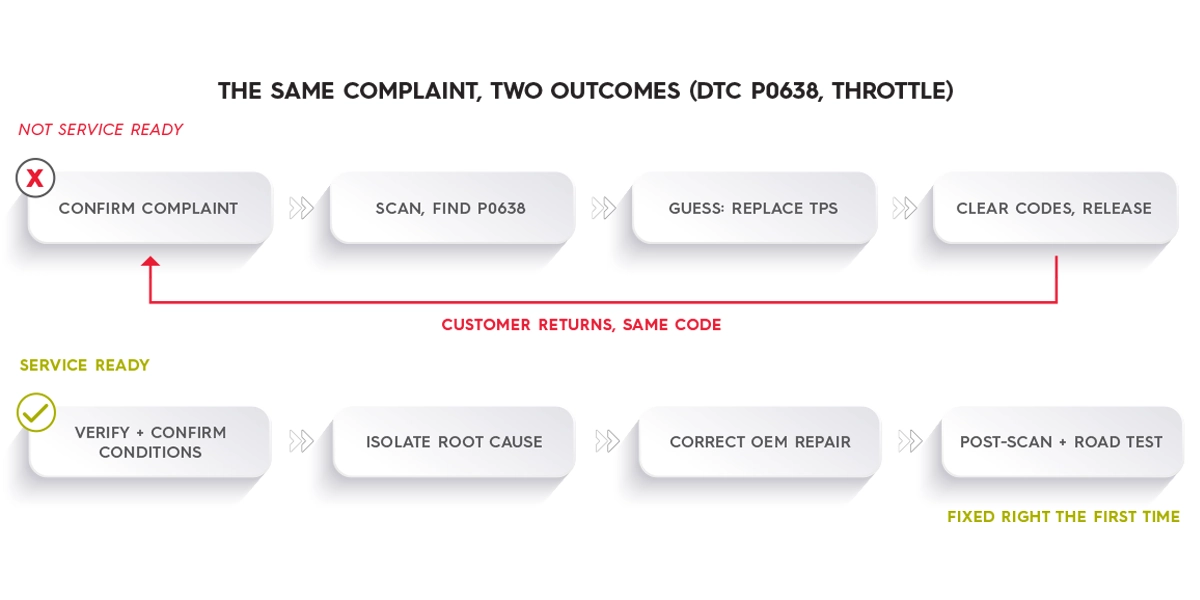
At a shop not service ready, a technician might confirm the complaint, scan the vehicle, and identify DTC P0638 (throttle actuator range or performance).
The technician might next locate a TSB applying to earlier models involving a throttle position sensor (TPS). They may test the TPS, find no obvious issues, clear the codes and release the vehicle with its malfunction still very much in play.
Or they may replace the TPS just in case, clear the codes and release the still-out-of-service vehicle.
In either instance, the customer will come back with the same symptom and the same code, because the root cause was never identified and the correct procedure, tools, information or parts were not in place to perform the appropriate repair.
Risk Mitigation and Service Readiness for Fleet Operators and IAM Networks
For fleets and independent aftermarket (IAM) service networks, service readiness is a risk-control lever. Here, it protects uptime and total cost of ownership (TCO) by preventing avoidable downtime, repeat failures and inconsistent repair quality across locations and vendors.

Service operations should ensure the following measures are in place to prevent special area issues with low service readiness:
EV heavy-duty specific risks
- Uptime (vehicles out of service, missed routes): Build EV-specific triage using telematics, DTCs and charging history. Keep the required high-voltage (HV) tools and PPE on site. Stage high-frequency EV wear items so repairs proceed effieciently without waiting on prerequisites
- High-voltage safety and liability: Enforce technician qualification levels, lockout/tagout (LOTO), insulated tooling and PPE controls. Establish defined de-energization and verification procedures before starting any HV work
- Thermal event and incident response: Establish written response procedures (isolation, monitoring, fire-department interface, quarantine area), train the team and define pre-plan towing and yard handling for damaged packs
- Charging uptime (charge failures): Assign clear ownership of charger diagnostics (facility, fleet, or vendor), keep spares on hand for common charger components, use data-driven alerts to resolve issues before they strand vehicles
- Derate and limp mode (power-limited vehicles): Employ consistent diagnostic workflows for thermal management, HV isolation and DC fast-charge faults. Validate all repairs with a road test and post-repair scan to prevent repeat derates
- Roadside events and recovery: Pre-qualify EV-capable heavy towing partners, define safe recovery steps for HV vehicles, make sure operators know what to do when a vehicle is disabled or in an isolation-fault state
- Battery health and warranty exposure: Capture all required fault evidence (DTCs, freeze-frame, HV measurements, charge logs) and follow OEM battery-handling rules to protect claim eligibility and improve recovery outcomes
- Facility readiness (space, lift, quarantine, ventilation): Define minimum bay requirements for EV heavy vehicles, provide safe pack-handling equipment, maintain a designated isolation area for damaged batteries
- EV and ADAS calibration: Require role-based safety training. Ensure presence of correct fixtures and targets. Provide calibration verification steps to prevent unsafe conditions and liability exposure
General fleet and IAM risks (all asset types)
- Cost leakage (sublet, rework, emergency sourcing): Use approved procedures, ensure tool availability (including loaner or pooled tools for low-use items) and set parts standards to prevent premium freight, duplicate labor and unnecessary replacements
- Network inconsistency (across sites and vendors): Deploy common checklists, minimum capability standards and a repeatable documentation standard to ensure consistent outcomes at every location
- Regulatory and inspection compliance (DOT, DVIR, emissions): Keep inspection training current, use the correct forms and calibrated equipment, set clear sign-off controls for who handles each certification
- Preventive maintenance execution: Implement Preventive Maintenance (PM) standard work, parts and tool kits by asset type, so PMs are completed consistently and catch defects before they become road calls
- Parts availability and sourcing: Use a standardized parts catalog with approved substitutes, track fill rate and define escalation rules for constrained parts to minimize downtime
- Data and diagnostics: Maintain scan-tool and software currency, credentials and guided diagnostics. Capture key data (DTCs, freeze-frame, test results) to support remote help and trend analysis
CONTROLS AND CADENCE
Once established, it’s important to make sure Service Readiness remains an active cornerstone of operations. Simple governance keeps readiness from drifting:
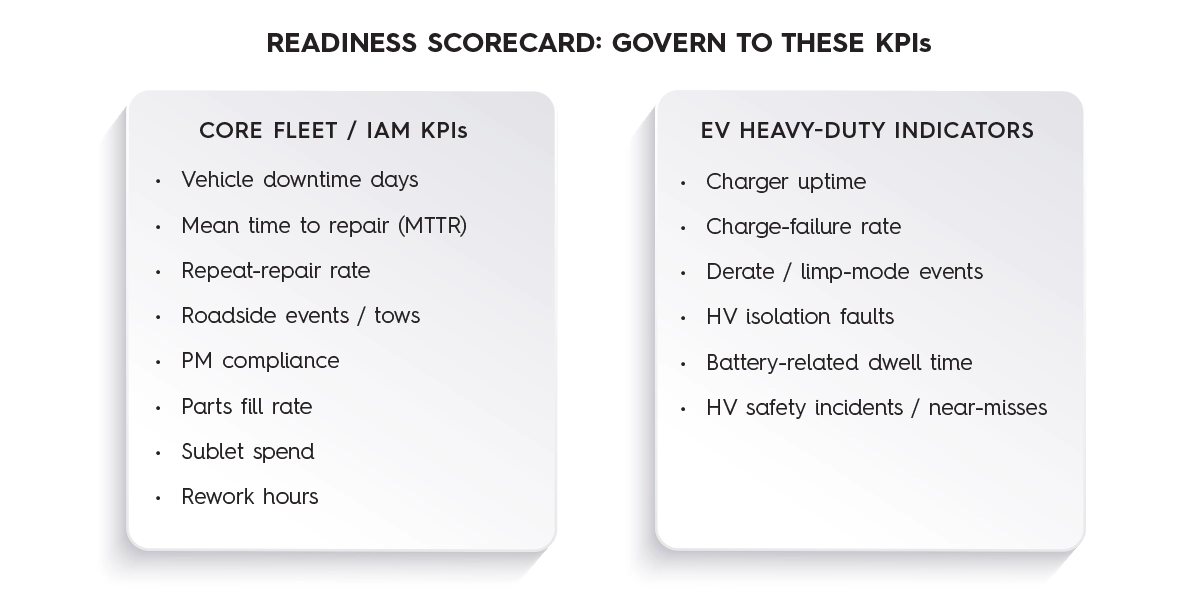
- Quarterly capability reviews (HV qualification coverage, tools and PPE, scan and software access, and facility requirements by asset type)
- Periodic vendor and site audits
- KPI tracking
Core KPIs include vehicle downtime days, mean time to repair (MTTR), repeat-repair rate, roadside events and tows, PM compliance, parts fill rate, sublet spend and rework hours.
EV-heavy indicators add charger uptime, charge-failure rate, derate and limp-mode events, HV isolation faults, battery-related dwell time and HV safety incidents or near-misses.
These trends help to target training, tooling, parts strategy, charger reliability, or vendor corrective actions.
The Economics of Service Readiness
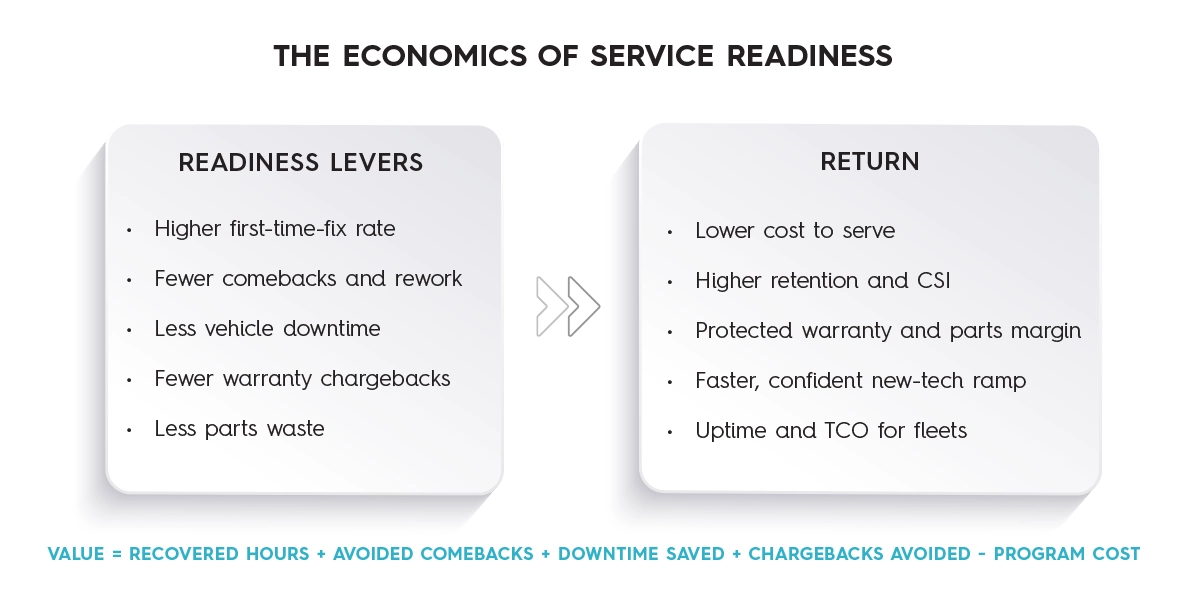
Readiness earns its budget in fixed operations. The levers are straightforward. Each lever maps directly to money a business already currently spends or loses.
Moving forward from these givens, it’s easy too how Service Readiness value comes from a range of compounding effects:
- Recovered technician hours: faster, first-time-right diagnosis restores billable and productive hours previously consumed by misdiagnosis
- Comeback prevention: each repeat visit prevented eliminates rework labor and misordered parts, while protecting customer goodwill
- Downtime saved: for fleets a vehicle back in service sooner is revenue protected and a route kept. For owners, retention
- Warranty chargebacks avoided: correct (and correctly documented) repairs pass audit and are not denied or clawed back
- Less parts waste: accurate diagnosis and correct parts identification cut unnecessary replacements and returns.
Put simply, value equals recovered hours plus avoided comebacks plus downtime saved plus chargebacks avoided, minus the cost of the program.
In a comparable deployment, Troubleshooter cut help-desk calls by 30 percent, unnecessary parts by 15 percent and diagnostic hours by 25 percent. ROI was typically realized within the first year.
The exact numbers depend on scale and starting point, which is why the Maturity Self-Assessment provides an excellent starting point.
The Service Readiness Maturity Model
Fortunately, service readiness is not an all-or-nothing proposition.
Most organizations sit somewhere on a curve from reactive to predictive. Knowing where your organization lies is the first step toward meaningful improvement.
The following five level describe this curve:
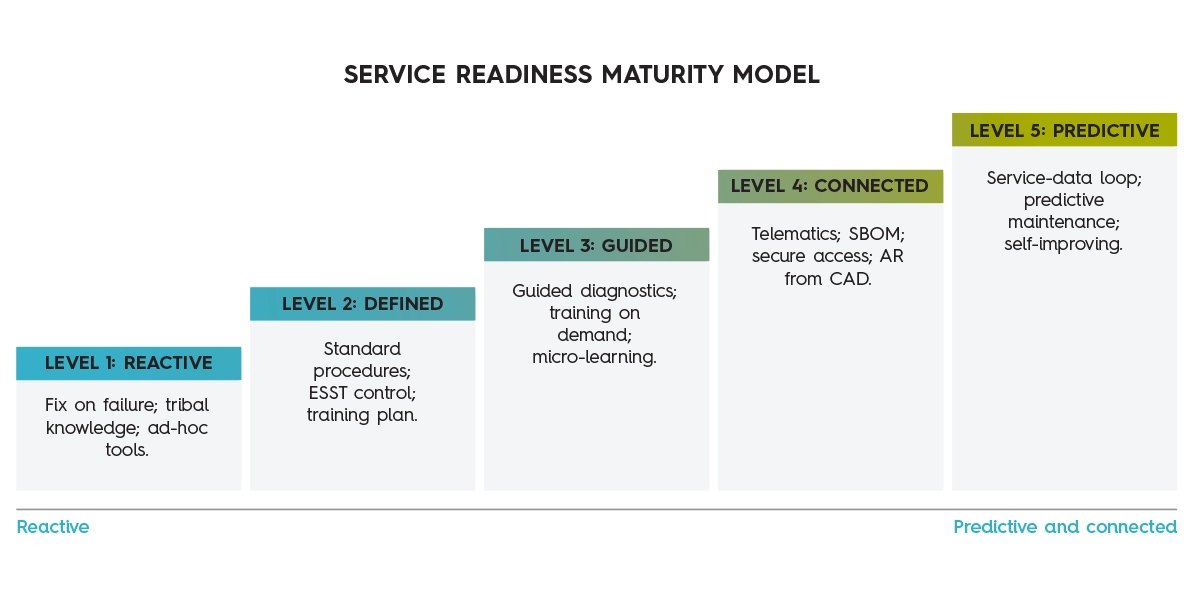
- Level 1, Reactive: Repairs happen on failure, guided by tribal knowledge and whatever tools are on hand
- Level 2, Defined: Standardized procedures, ESST control and a training plan are clearly established
- Level 3, Guided: Guided diagnostics, training on demand and micro-learning are active and capable of ensuring the effectiveness of all on-site technicians
- Level 4, Connected: Telematics, a well-maintained SBOM, secure access and Augmented Reality (AR) from CAD serve to connect the vehicle, its data and the technician
- Level 5, Predictive: A closed service-data loop drives predictive maintenance and a self-improving system
A Quick Self-Assessment
For each technician capability, tooling and ESST control, service information and software, secure access, and use of service data, mark the level that best describes you today.
The lowest score is usually where the next investment pays back fastest. The solution, in each case, is rarely simply more training.
On the contrary, Level 3’s guided layer typically provides the greatest improvement, by raising existing tools and people to a higher level of performance.
Glossary
- ADAS: advanced driver-assistance systems such as automatic emergency braking and lane keeping, which require calibration after many repairs.

- Core return: returning a failed but rebuildable component so it can be remanufactured.
- CSI: customer satisfaction index, a common measure of the service experience.
- DTAC: dealer technical assistance center, and the troubleshooting solutions it publishes.
- DTC: diagnostic trouble code, the fault code a control unit records.
- EPC: electronic parts catalog, the system that identifies the correct parts for a repair.
- ESST: essential special service tool, specified by OE engineering to complete a defined repair to specification.
- FTFR: first-time-fix rate, the share of repairs completed correctly on the first visit.
- HV: high voltage, the electrical systems in EVs and hybrids that require qualified handling.
- MTTR: mean time to repair, the average time to return an asset to service.
- OTA: over-the-air, software or firmware delivered to the vehicle remotely.
- PID: parameter identifier, a live data value read from a control unit.
- PIP: product improvement program, an OEM-issued update to a repair or component.
- R and I: remove and install, and by extension remanufacturing of removed units.
- SBOM: service bill of material, the list of a vehicle serviceable modules with their software and firmware versions.
- TCO: total cost of ownership, the full lifetime cost of operating an asset.
In our next installment, we’ll examine the processes and best practices involved in bringing the individual technician onboard for a comprehensive service readiness initiative.