Software-defined vehicle service has increasingly become an inescapable fact for dealer and independent service outlets.The landscape emerging from this development introduces a number of unique demands, but OEMs stand to create a set of advantages for themselves simply by approaching those demands correctly.
Previous Installments in the Service Readiness Series: Part One | Part Two | Part Three
In Part 4, Ralph Pompea explains how one secure, authenticated access layer to the vehicle pays off four times over: it keeps a mismatched update from bricking a control unit, it meets the cybersecurity and software-update rules that now govern type approval in many markets, it captures the service data that makes maintenance predictive, and it lets an OEM say yes to independent repair access without losing control of quality or security. Getting there takes configuration discipline, real cybersecurity, and a closed service-data loop.
Supporting the Software-Defined Vehicle
Modern vehicles are increasingly software-defined. Function now lives in dozens of networked electronic control units, each running its own software and firmware. A growing share of repairs involve software or firmware updates rather than, or in addition to, mechanical adjustments. Correct service for software-defined vehicles demands knowing exactly what software is installed on the vehicle before anything is changed.
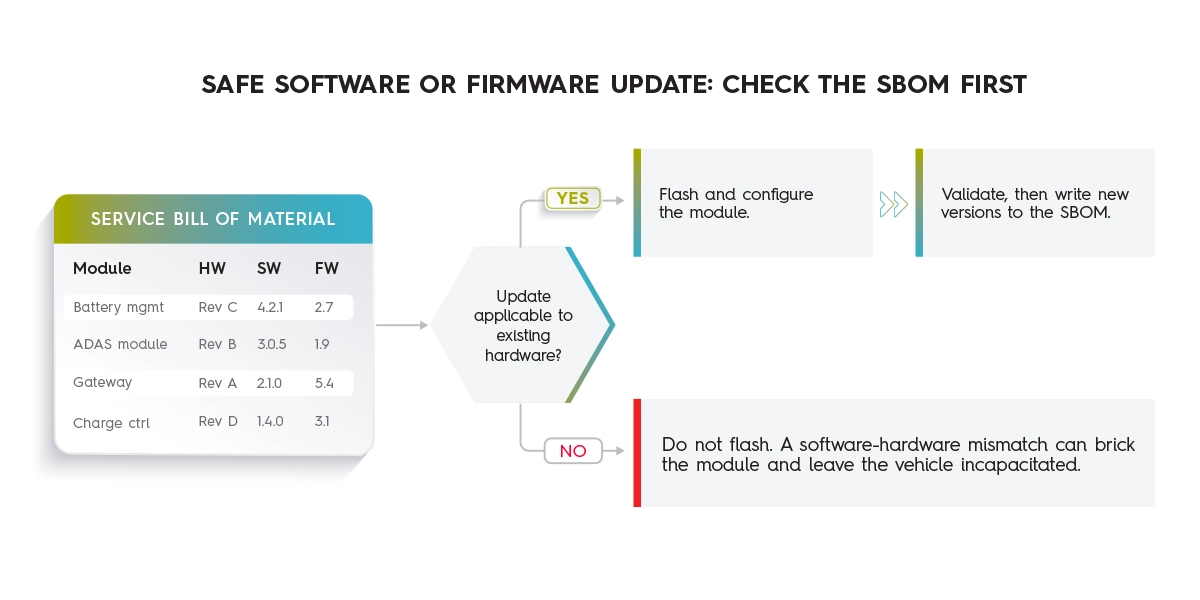
This is why every vehicle should carry a Service Bill of Material (SBOM): a complete list of its serviceable components detailing each module, its current software and current firmware version. The SBOM provides an authoritative record of the vehicle configuration and the starting point for any software-related repair.
Successful management of these conditions depends on the following best practices:
- Maintain a complete SBOM: Track every serviceable module. Note its current hardware revision and software and firmware version.
- Confirm applicability first: Before any software or firmware update is applied, validate it against the SBOM’s recorded module hardware revision.
- Sequence paired repairs: When a fix requires updates for both hardware and software, perform them together and in the correct order.
- Validate and record: Verify the module configuration after the update and write the new versions back to the SBOM.
This single applicability check prevents a software-hardware mismatch from bricking a control unit and incapacitating an entire vehicle.
Recovering a bricked module is slow and costly, and sometimes the module still needs to be replaced. It’s far cheaper, and less time consuming, to confirm alignment between software and hardware first.
Some system repairs require both hardware and software updates, for example, replacing a control unit and then flashing and configuring it to match the vehicle. The SBOM clarifies these dependencies, so the technician completes both steps and validates the result rather than discovering a mismatch afterward.
Guided diagnostics brings a practical approach to software/hardware compatibility right into the service bay.
An effective guided diagnostics procedure reads the vehicle module and version data and checks update compatibility against the SBOM before a flash is permitted. It prescribes paired hardware-and-software changes in the correct order and records the post-update configuration, which is extremely valuable for later reference.

More advanced guided diagnostics systems extend this protocol to include telematics. In these instances, the technician can proactively review a software-defined vehicle’s version and configuration state before the vehicle even arrives.
For fleets and dealer networks alike, a properly maintained SBOM, combined with an enforced applicability check, often decides the difference between a routine update and asset downtime.
Cybersecurity and Secure Vehicle Access
As diagnostics and updates move to software, access to the vehicle becomes a security decision as much as a service concern. Software-defined vehicles place diagnostics, reprogramming and over-the-air updates behind a secure gateway. It’s worth mentioning, too, that regulators now require it: UN Regulations R155 and R156 make cybersecurity management and software-update management a condition of type approval in many markets.
So, service readiness must include secure, authenticated access, not a shared password taped to a laptop.
Readiness for secure access rests on a few principles:
- Authenticated identity: Every technician or independent repair provider accesses the vehicle with verified credentials and a defined role. Shared or anonymous logins are not permitted.
- Least-privilege authorization: The secure gateway limits access to only what a given task requires.
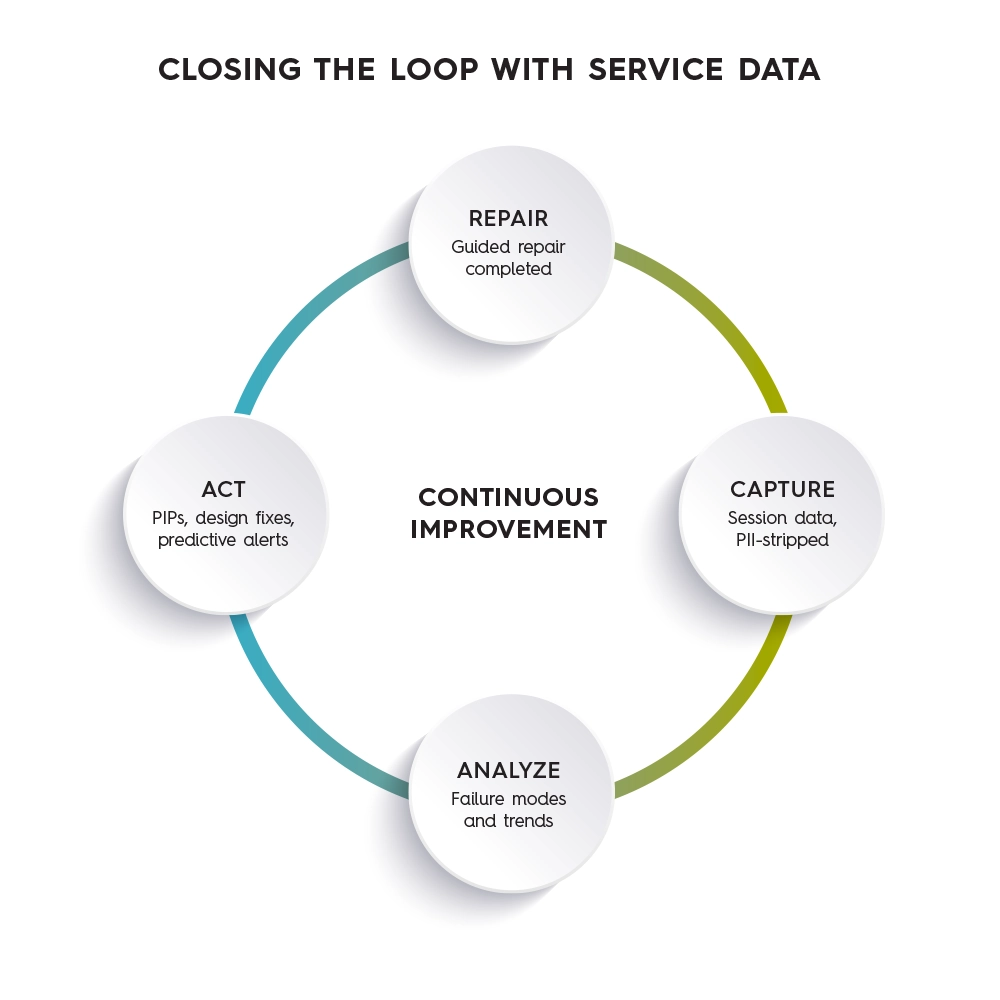
- Tamper-evident audit trail: Every session and change is logged, so the record shows who did what and when. This protects the shop, the owner and the OEM.
- Update integrity: Software and firmware are verified as authentic and unaltered before they’re applied, which is consistent with R155 and R156.
This closes the gap between the field and engineering for OEMs, and it’s especially valuable for the legacy fleet: older units with little telematics, where an OEM often has little visibility into how the product actually fails. For a fleet or IAM network, this same loop reduces downtime and the overall cost of ownership.
Advanced guided diagnostics systems extend this even further for software-defined vehicles, using telematics to flag a developing issue and stage the repair before the vehicle arrives.
Right to Repair, Software-Defined Vehicles and the Regulatory Landscape
Service readiness now sits inside a shifting legal landscape.

Right-to-repair rules increasingly require manufacturers to give owners and independent repair providers access to the same diagnostic and repair resources their dealers use, and to do it on fair terms.
- Agriculture: A 2026 FTC settlement with Deere & Company requires it to give farmers and independent repair providers the same fault-code, reprogramming, and troubleshooting resources its dealers use.
- Automotive: Massachusetts’s telematics right-to-repair law, and broader state activity, push the same access requirement onto vehicle makers.
- Europe: Access-to-repair-information rules, together with the UN R155 and R156 cybersecurity and software-update regulations, now shape how repair access and secure updates coexist.
- The tension to manage: Opening access while protecting safety, cybersecurity and intellectual property, which is exactly what authenticated, audited, guided access is designed to do.
The readiness implication is direct. Manufacturers that treat mandated access as a compliance burden will do the minimum; those that deliver it through a secure, guided platform turn the obligation into a controlled channel that protects the brand, captures service data, and still meets the letter of the rule. Guided diagnostics is the mechanism that lets an OEM say yes to access without losing control of quality or security.
In its next installment, the series takes on Essential Tools and Global Service Strategy. Watch for Service Readiness, Part 5.