Service readiness training, guided diagnostics, training on demand, micro-learning, augmented reality, and the service content behind them: In Part 1 of the Service Readiness Series, Ralph Pompea outlined the overall business case for making service readiness an operational priority.
Now, in Part 2, Ralph Pompea explores the importance of training your technicians using guided diagnostics, short-form micro-learning and augmented reality from OEM CAD data. It also details how managing your structured authoring systems helps keep all that information accurate and accessible.
Building Diagnostic Confidence
Modern vehicles demand more from technicians than ever before. As vehicle systems become increasingly connected and complex, effective service depends not only on technical knowledge, but on the ability to follow a disciplined diagnostic process, use the right tools and information, and confidently apply OEM procedures.
For dealerships, training is therefore more than a way to introduce new technology. It’s an investment in fix-right-first performance, technician productivity, warranty compliance, customer satisfaction and long-term service retention.
A comprehensive service readiness training strategy for OEM dealers should connect diagnostic proficiency, product and procedure knowledge, tool readiness and fixed-operations processes into one consistent approach.
Service Readiness Training and Diagnostics for Technicians
A dealership’s service readiness training plan should reinforce the OEM-approved diagnostic workflow, ensure the proper use of OE scan tools and communicate the repair-validation steps necessary to protect both the customer experience and the OEM warranty process.
Training on Demand
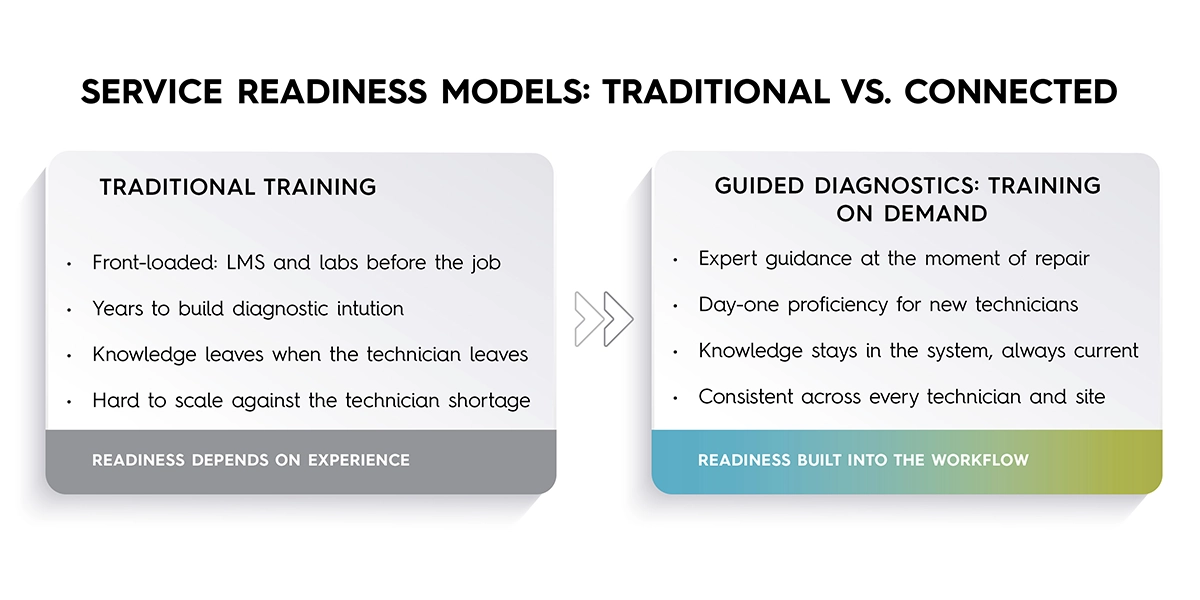
Traditional training is front-loaded. Technicians complete LMS modules and labs before they touch the vehicle, then spend years building the diagnostic intuition that separates a correct repair from a guess. The technician shortage makes that model hard to sustain, and the knowledge walks out the door when a veteran leaves.
Guided diagnostics inverts the model: It delivers the expert procedure at the moment of repair, so a newer technician performs at a veteran level from day one and the knowledge stays in the system. Training becomes a continuous, on-the-job capability rather than a one-time, pre-launch event.
Micro-learning: Short Video at the Point of Need
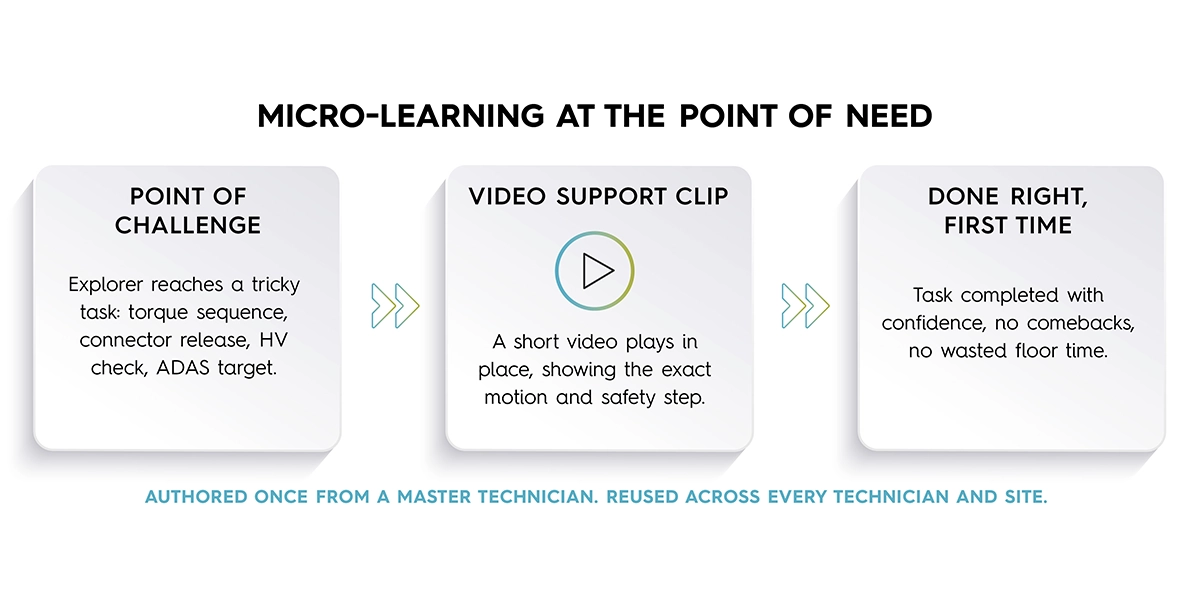
Text isn’t always the best mechanism for knowledge transfer. Think about a torque sequence, connector release, high-voltage de-energization check or ADAS target setup: these processes are often made clearer by just a few seconds of video than a paragraph of procedural description (which still might not communicate the necessary information). Short, task-specific video clips, usually 30 to 90 seconds in duration, deliver physical procedural knowledge exactly where and when the technician needs it.
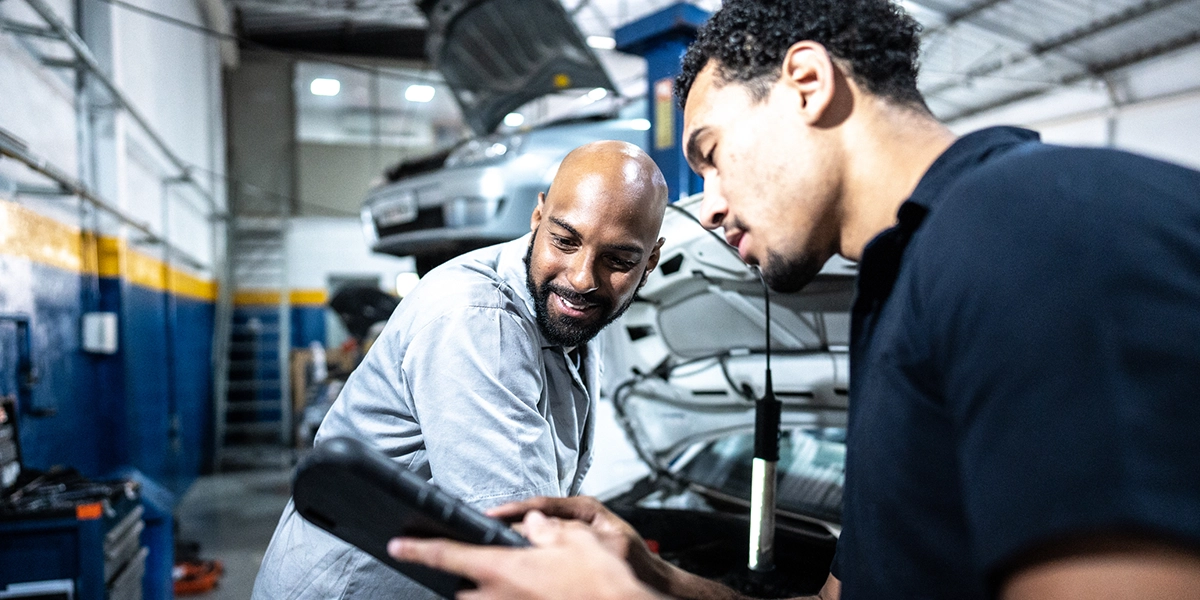
As an example, Tweddle Group’s Troubleshooter tool attaches these clips to the guided procedure in Designer and plays inside Explorer at the relevant step. The technician never leaves the workflow to hunt for a how-to clip. They simply view the clip within the procedure itself. Learning occurs in the bay, during the actual repair, not in a classroom weeks earlier.
This approach benefits service readiness and technicians in multiple ways:
- Time of need, not time of hire: The lesson arrives at the moment of the task. The proficiency does not depend on scheduled training.
- Show, don’t tell: Video captures the motions, sequences and safety steps that text and static diagrams miss.
- Scale a master technician: Record expert know-how once and make it available to every technician and site. This preserves tribal knowledge as veterans retire.
- Launch and safety ready: New-platform and HV or ADAS steps can be clipped and pushed the moment procedures change.
- Bite-sized and reusable: Short clips are faster to produce, easier to keep current and searchable within the guided flow.
 Augmented Reality: Animated Repairs from OEM CAD Data
The richest form of guidance goes beyond video. Using an OEM’s own CAD data, Troubleshooter generates augmented-reality overlays and 3D animations to show a component coming apart and going back together in the correct sequence. Technicians can compare these demonstrations to the part in front of them. Because the animation is built from engineering CAD, the guidance matches the as-designed product exactly and updates when the design changes, so the technician is never working from a generic or outdated illustration.
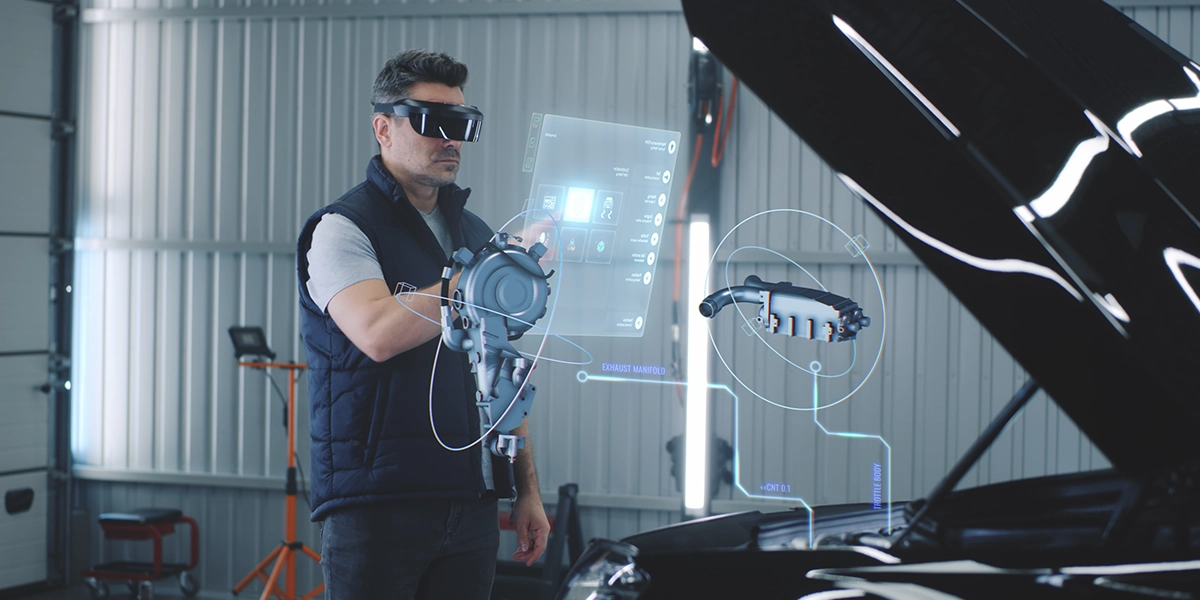
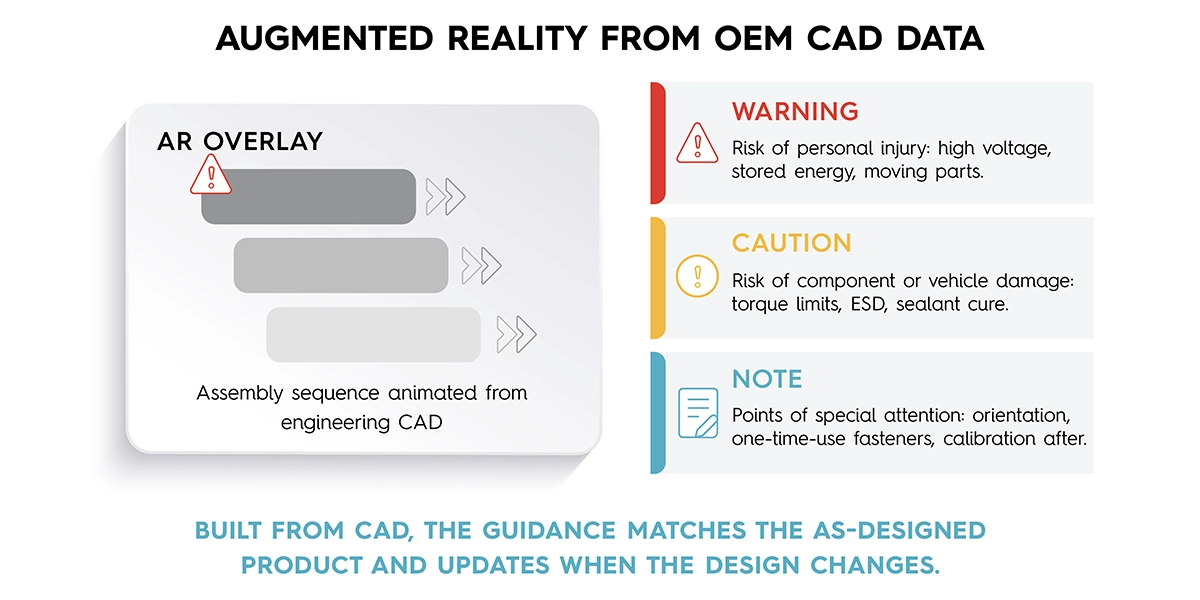
Delivered as part of the Troubleshooter offering, these AR sequences attach to the guided procedure in Designer and play in Explorer at the exact step, with the Warning, Caution, and Note cues surfaced in context rather than buried in some disregarded preamble.
The result is correct assembly the first time, fewer damaged components, safer high-voltage and ADAS work and immediate proficiency on new or complex assemblies. This is extra useful if a technician has never actually seen a particular platform.
Teams can author a tutorial animation from CAD before the first unit even reaches the bay.
Authoring and Localizing Service Content at Scale
Service readiness training also depends on content maintenance. For a global product line with many variants, that’s a discipline in itself. Content should be authored once and reused everywhere, kept in step with engineering changes and delivered in every market language. Modern content operations rest on a few fundamental principles:
- Structured authoring: Teams should adopt an authoring standard like DITA or S1000D. Content should be modular, consistent and reusable rather than locked inside documents.
- A content management system (CCMS): Single-sourcing, version control and variant management ensure each change propagates everywhere it applies.
- Translation and localization: Translation memory and localization workflows translate a single source into every market language without re-authoring.
- Multi-channel publishing: One single source feeds guided diagnostic and repair procedures, technical and owner manuals, parts catalog and owner portals.
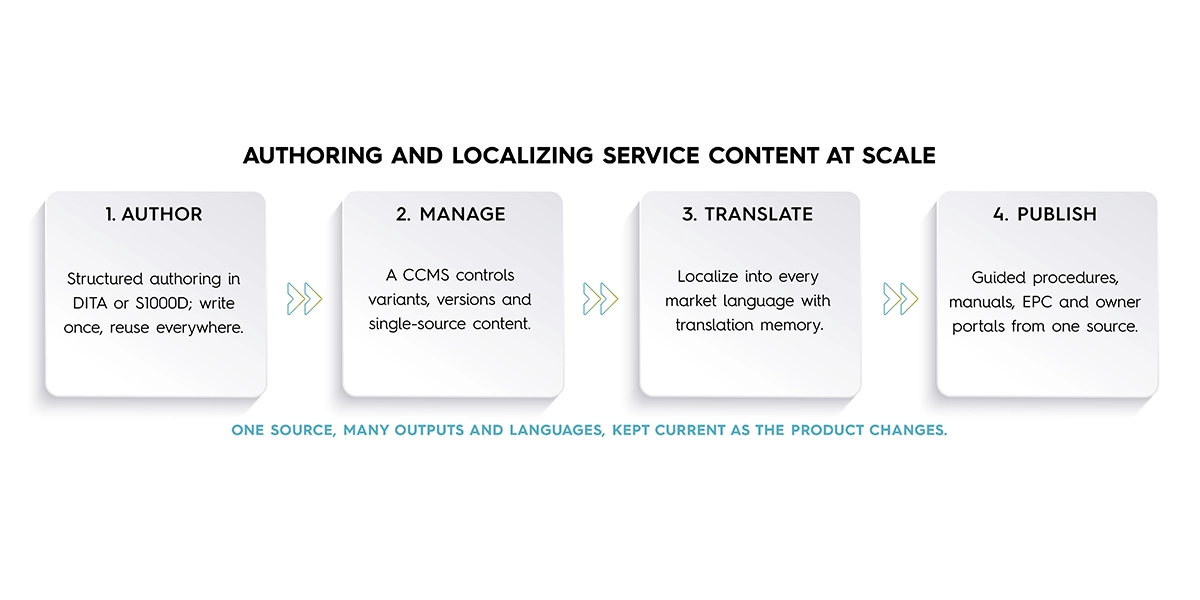
Authoring content once, then publishing everywhere ensures accuracy and alignment of your guided diagnostics, electronic parts catalog and ownership experience. These elements all combine to create launch readiness: procedures for a new platform can be authored and localized before the first unit reaches the field.
The Business Impact of Better Service Readiness Training
Service readiness training generates measurable benefits when it connects directly to dealership processes and performance.
Consider a vehicle arriving with an intermittent malfunction indicator lamp and a throttle-related diagnostic trouble code.
Instead of replacing the most obvious component, a properly trained technician can use freeze-frame information, PID graphing and targeted harness/connector testing to identify the actual root cause. A post-scan and validation process then confirms issue resolution. The result is a stronger First Time Fix Rate and a lower likelihood of repeat visits.
This same discipline also lowers warranty risk. When a repair order includes the required pre- and post-scan information, diagnostic steps, test results and accurate TSB applicability based on VIN, the documentation better supports the repair and reduces the risk of rework, claim delays and chargebacks.
Training can also improve cycle time. A technician who quickly locates the correct OEM procedure, specifications, wiring information and connector views spends less time searching and more time diagnosing and repairing. This lowers diagnostic dwell time and frees valuable bay capacity for the next appointment.
Preparation also pays off in programming and calibration. Following a standardized programming setup checklist—including appropriate battery support and connectivity—along with required relearns and verification procedures—helps reduce failed programming events and keeps a vehicle from occupying the bay longer than necessary.
For a customer, the impact is often most visible when a repair is completed correctly the first time. An accurately-performed ADAS calibration or properly completed technology repair helps eliminate an additional visit, improves confidence in the dealership and helps advisors set more accurate expectations.
Service readiness training also plays a critical role in new-model launch readiness. When technicians complete the appropriate eLearning and hands-on training before a new platform arrives, they approach initial service concerns with the knowledge, equipment and procedures needed to resolve them without unnecessary delays or dependence on outside support.
Finally, effective training improves the value of the dealership’s investment in essential service tools. With clear tool-control and return-to-home standards, the right fixture or piece of equipment is available, calibrated and complete when the job requires it. That reduces job stoppages, improvised repair methods and avoidable tool damage.
APPENDIX: Diagnostic Training (Process and Proficiency)
- OE scan-tool discipline: pre-scan and post-scan, DTC context (current and history), freeze-frame use and the documentation required for warranty stories.
- Guided diagnostics and data analysis: PID selection, graphing, bidirectional controls and knowing when to confirm with a scope or meter to avoid repeat repairs.
- OEM diagnostic workflow: verify the concern, confirm conditions, isolate root cause, perform the OEM repair, validate the fix, complete the required post-repair checks and confirm with a test drive.
- OEM service-information mastery: selecting the correct procedure by VIN and production range, correct TSB applicability, wiring and connector views and specifications (torque, fluids, sealants) to prevent comebacks.
- Network and module readiness: CAN and LIN diagnostics basics, programming setup requirements (battery support, connectivity) and post-programming verification.
Technician Training (Product, Tools and Procedures)
- New-model and technology launch training: platform changes, common early-life issues, EV/HEV safety and ADAS fundamentals, all aligned to the OEM launch timeline.
- OEM procedure compliance: calibrations, relearns, torque-to-yield, one-time-use fasteners, fluid specs and validation steps needed to protect warranty and reduce repeat visits.
- Essential-tools proficiency (ESST and required equipment): correct setup, safe use, calibration and maintenance and tool control to ensure the right tool is available when the vehicle arrives.
- Fixed-operations consistency: standard work, checklists, and foreman/dispatcher handoffs to protect throughput, quality and technician productivity.
How to Implement and Position Training
- Assess the dealer’s gaps: top comeback and warranty categories, long-diagnostic-time jobs and where the team struggles (service information, scan-tool usage, programming or ESST availability).
- Align with dealer roles: define what technicians, the foreman or dispatcher, the service manager and the warranty administrator each must do to support a compliant diagnostic-to-repair workflow.
- Use a blended delivery model: OEM Learning Management System (LMS) and online modules for knowledge, plus in– shop hands-on labs for scan-tool workflows, ESST usage, calibrations and complex diagnostics.
- Measure what matters in fixed ops: fix-right-first, repeat-repair and comeback rate, diagnostic time, programming success rate and warranty-chargeback risk, plus bay and technician utilization.
Connect to dealer outcomes: higher CSI, faster appointments, fewer repeat visits, stronger retention and a department that can confidently support new-model launches
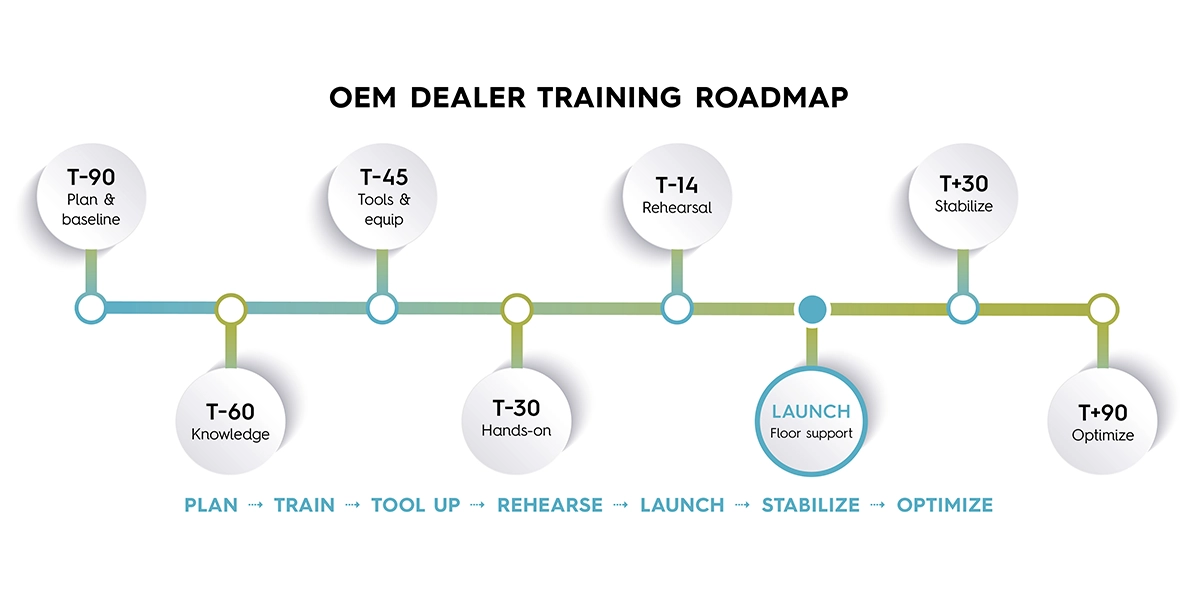
OEM Dealer Training Roadmap (Timeline Milestones)
- T-90 days (plan and baseline): confirm launch scope (platform, trim, technology),
identify dealer roles impacted, baseline current KPIs and publish the training calendar. - T-60 days (knowledge readiness): complete OEM LMS modules for technicians and advisors, verify access to service information, programming subscriptions and credentials and required scan-tool and software versions.
- T-45 days (tool and equipment readiness): receive and install required ESSTs and equipment, validate calibration and maintenance status and define tool control plus return-to-home storage location.
- T-30 days (hands-on proficiency): run in-shop labs on OE scan-tool workflows, guided diagnostics, programming-setup checklist (battery support, connectivity) and the most likely early-life repairs and calibrations.
- T-14 days (process rehearsal): role-based drills with foreman, dispatcher, service manager and warranty admin covering repair-order documentation, parts ordering, escalation path and what done looks like (post-scan, test drive, calibration verification).
- Launch week (floor support): daily quick huddles, confirmed tool availability, early cases captured/shared, programming and calibration work scheduled with the right bays and time windows.

- T+30 days (stabilize): review first-month cases and KPIs, deliver targeted refreshers on the top three repeat issues and confirm whether warranty documentation is passing internal checks.
- T+90 days (optimize): formal performance review against baseline, updated standard work and checklists and an adjusted training plan for remaining gaps and new bulletins.
- Higher fix-right-first: A vehicle arrives with an intermittent MIL and a throttle-related DTC. Instead of swapping the likely part, the technician uses freeze-frame, PID graphing and a quick harness/connector test to isolate the true root cause and confirms the repair with a post-scan, preventing a repeat visit.
- Lower warranty risk (chargebacks): A claim is supported with the required pre-scan and post-scan results, the test steps performed and the correct TSB applicability by VIN, so the repair-order story matches OEM expectations, pre-empting any rework or denial.
- Faster cycle time and more throughput: A new technician finds the OEM procedure, specs and connector views in minutes rather than hours, reducing diagnostic dwell time and freeing the bay for the next appointment.
- More successful programming and calibrations: After a module replacement, the team follows a trained programming-setup checklist and completes the required verification and relearns. This prevents a failed flash and it frees the bay for more work.
- Improved CSI and retention: An ADAS calibration is performed correctly the first time, eliminating a second visit and giving the advisor confidence to set accurate expectations.
- Launch readiness: Before first deliveries of a new platform, technicians complete new-model eLearning plus an in-shop lab on the required ESSTs, so the first concern can be repaired without waiting on a field engineer.
- Better ESST utilization and availability: With tool control and return-to-home standards, the required fixture is available, calibrated and complete when needed, preventing job stoppage, improvised methods, or tool damage.
What’s the real business value of service readiness? Does service readiness generate revenue and, if so, exactly how?
We’ll answer these questions in our next installment, and find out how service ops transform everyday checks (battery health monitoring?!) into boosted revenue, in Service Readiness Part 3: The Aftersales Revenue Machine.