What can you tell me about that?
Well, this new platform is very much a counterpart solution to the original TRACER platform. It emerged from the same technology, but whereas TRACER is a manufacturing solution, this is geared specifically for service. It’s essentially a functional diagram navigator.
That was its initial ‘code name’ or working designation, right? Functional Diagrams?
Exactly. When we first isolated this feature it was referred to as the Functional Diagrams tool, and since then it’s matured into a standalone offshoot of TRACER.
It’s essentially TRACER’s ‘Expert Mode’, meaning it’s specifically for technicians, and it’s been officially designated TRACER-X.

How is TRACER-X distinct from TRACER, and how do they overlap?
So, when a manufacturer goes online with TRACER, there’s this ingestion of data, right? This data gets leveraged out into TRACER, so TRACER can do its thing, which is identifying the root cause among a complex cluster of DTCs [diagnostic trouble codes].
Where the two systems are distinct is in how TRACER-X uses the exact same datasets to offer different options for navigating the circuit architecture of a particular product—a vehicle, a machine or what have you.
So, whereas the TRACER platform itself is designed to flag root-cause DTCs, TRACER-X is very much a tool for the technician, and a way for them to perform deeper diagnostic investigations.
If I’m a manufacturer, and I’ve got my own service operation, let’s say. What benefit or advantage does TRACER-X bring to the table? Why should I be interested?
Short answer: How does $100,000 per vehicle sound?
(Laughs) I’ll take it.
Right? (Laughs) It sounds good to me.
Like we talked about before, one of our clients used an early version of TRACER-X to slash the hell out of their development times and, by extension, their costs.
Building and updating wiring diagrams for a product, that development, it’s always been a manual process. It’s labor-intensive. With TRACER-X, it’s just a matter of ingesting existing engineering data, and then the system produces the necessary content. It’s a great way to approach development.
Right? Because the data is already there. And this platform takes that data, turns it around, and generates these interactive wiring diagrams pretty much instantaneously.
And, sure enough, our client took those costs from just under $200,000 per vehicle to $70,000 or $80,000 per. So, they saved around $100,000 on each vehicle.

This is back when it was called Functional Diagrams.
That’s right. And the tool was, at that time, a downstream byproduct of TRACER. It was just becoming its own separate tool.
Seeing our client gain that sort of ground with it… you know, that was one of the moments where we said, “This thing has a remarkable utility all on its own, both for the technicians and on the development side.”
So, it’s cutting development costs. That’s money, there, right off rip.
It’s also speeding up accurate diagnostics and other activities in the service bay, because it liberates the technician from having to cross-reference all these different static documents.
Many of which are fairly clunky, right?
Absolutely. (Laughs) You’re familiar?
I mean, I deal with static schematics at home on a much smaller scale. Small electronics.
Okay. Are you a fan?
I am not a fan. (Laughs) Granted, I’m not a technician or an electrician or anything like that, but I can easily extrapolate that experience and see how much better it would be to have an interactive wiring diagram where you navigate these 2D and 3D views of a circuit.
It’s pretty dramatic, and these technicians that have used it certainly appreciate the improvement.
So it represents an increase in efficiency and puts money back into the till on multiple different fronts.
That’s right.
Speaking of the technician experience, could we walk through the innovation here on the service side of things?
For sure. Let me start from the beginning.
To set up TRACER-X with an OEM, you know, ideally, we integrate with their scan tool first, or whatever tester technology they’re using. Either way, when the technician boots up the system, they’re looking at the VIN-specific payload for that exact product.
So, let’s say we’re trying to do pin-to-pin testing on the engine coolant temperature sensor.
When I select that, TRACER-X shows me the circuit diagram related to that particular subsystem, and lets me navigate those circuits either as a 2-dimensional circuit diagram, and I can drill down that way. But it will also present a glass view of the vehicle, and I can see the precise physical location of all this stuff within the vehicle itself.

So does TRACER-X save time for a technician?
You better believe it. Tons of time.
Normally, I’d be looking at a circuit diagram that’s, you know, a bunch of lines and blocks and things like that.
It wouldn’t give me any of the context I get from this glass view of the vehicle.
It wouldn’t tell me where these components are, physically, within the vehicle.
With TRACER-X, I can spot the connectors associated with the circuit. I can see where the circuit begins and where it ends. I can physically see where both connectors are.
That alone is a huge benefit, right? For a technician to have this visual context.
I can see which of these two connectors I need to go and disconnect for my pin-to-pin testing.
Instead of being restricted to the traditional schematic—although that’s still present and visible and available to reference—I can see where the harness is within the vehicle. The interface combines the information of several documents at once, so the technician doesn’t need to have all these different tabs open, and doesn’t have to switch back and forth between them.
You’re able to see the circuit diagram, you’re able to see the detail, you’re able to see the wire colors and the description. And, most importantly, you’re able to see the physical context of where these connectors are within the overall product architecture.
What options does TRACER-X give you for drilling down into that architecture?
And, now we’re talking. To take it one step further, in order for me to do any sort of pin-to-pin testing, I need to know which pin is relevant within the connector.
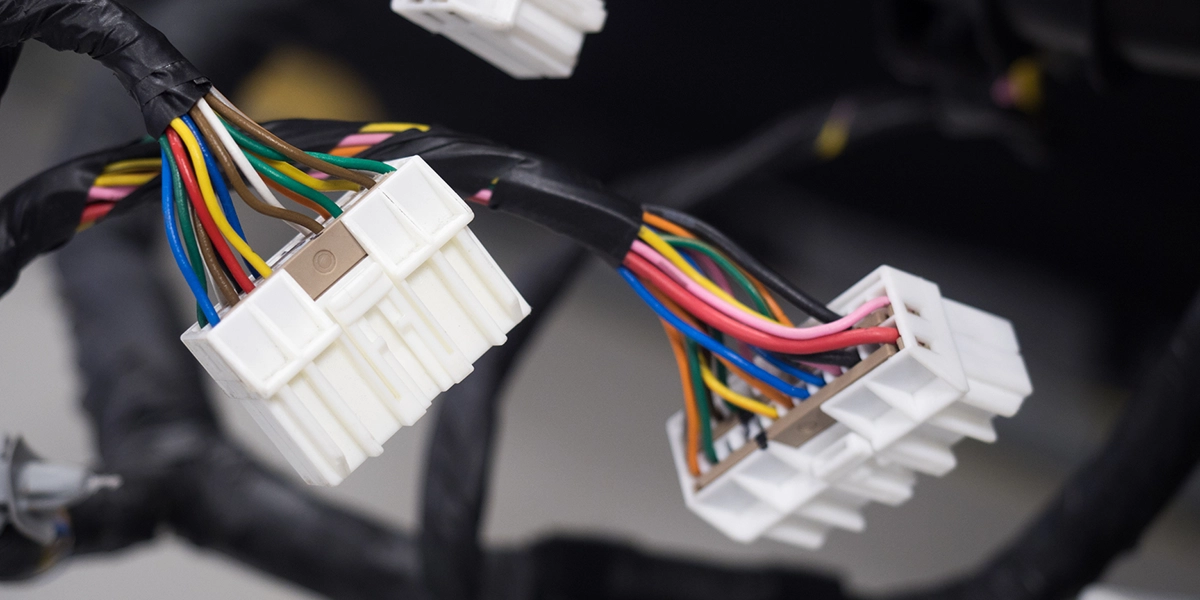
Bear in mind, a connector can have two wires or it can have 18 wires.
The platform lets me click and instantly see which pin I’m looking for.
So you’ve got this huge connector, and the system highlights exactly what I need. “Take a look at pin 12.”
What would a technician have to do otherwise?
Ugh. Cross-reference. Deduce. Count, right? Open another document on their laptop for reference.
With this system, the technician is able to flip between views knowing they need to go to this location, which connectors to disconnect, and which pins to examine or test on each connector.
For my own non-technical edification, what’s the next step once the tech has this info?
There are plenty of possible fault scenarios at this point. Is a wire pushed out? Is there some corrosion on one of the pins? Maybe you need to re-pin the connector.
Whether you’re running a multimeter test or ultimately disassembling the harness to locate a broken wire, the important thing is now you know exactly where to look. You found it fast and you found it with surgical precision.
You worked as a technician early in your career. Would this have helped you?
Absolutely. A lot of technicians rely extensively on what we always called ‘swapnostics’, which is where you identify as much of a familiar pattern as possible and then you just start swapping out whichever parts you think are the most likely culprit.
(Laughs) Okay. Swapnostics.
That’s right. And something like this is going to help technicians because it levels the playing field. Seasoned techs can get it done quicker, and less mature technicians can get it done in a comparable amount of time, too.
A lot of technicians know just enough to get in there and be dangerous, but often they’ll hit a wall if the part-swapping approach doesn’t work.
Their next step is always to go and hassle one of the older techs working in the shop. You know? Because there’s always that one technician in the room who really understands the architecture of the vehicles.
He’s over there, way into some complex repair. Here comes the younger technician, you know. “Hey, man. You got a second?” Heavy sigh. “What’s up?”
TRACER-X makes it so no one has to pull these more experienced techs out of their bays to come and help.
That’s why I think it represents a huge step forward, because it’s a massive time-saver for the more experienced techs, but it also has the capacity to turn your junior technicians into self-sufficient entities.
It creates a situation where the greener techs, your ‘parts changer’ folks, are accomplishing more. They’re not having to interrupt the folks who know what they’re actually doing.
So, everybody’s able to perform accurate service more efficiently.
Way more efficiently.
Nick, thanks!
Thank you.
Learn more about TRACER-X at Field Service Europe 2025, Booth 202, October 27-29, 2025, Hotel Okura Amsterdam, The Netherlands.