
Field Service Profitability Across Specific Industries
It would be obvious and easy to see every service operation as an extension of its respective industry: we see field service for farm equipment over here, automobile service over there (with automotive itself broken into even smaller, separate categories for internal combustion (ICE) vehicle service and electric vehicle (EV) service.
Speaking from the Field Service Europe event in Amsterdam, Tweddle Group Chief Business Development Officer Claude Vanbeveren says field service is better viewed as a distinct category unto itself spanning multiple industries. It’s a perspective he sees reflected by the structure of Field Service Europe.
“If you go to an automotive show, you only see cars,” Vanbeveren says. “If you go to a heavy equipment show, you only see heavy equipment. What I like about this conference is you hear issues from vastly different industries.”
That matters because while products differ, service challenges don’t. Whether it’s medical devices, heavy equipment, vehicles or coffee machines, every service organization faces the same fundamental tension:
How do you deliver fast, high-quality service without letting costs spiral out of control?
For many companies, the solution to this problem is the same today as it was 20 years ago: send out the technician, ship the necessary parts, hope for the best.
But in an era of connected products, advanced diagnostics and automated change management, that approach is increasingly expensive… and entirely unnecessary.

The High Cost of “Throwing Parts”
Vanbeveren spent much of his career working in spare parts operations, where the primary goal was simple: get the right part to the right place at the right time. Diagnosis often took a back seat.
“It was all about spare parts availability,” says Vanbeveren. “You just made sure the parts got there on time. We weren’t so much diagnosing the problem, just throwing parts at it.”
That mindset still dominates many service organizations today. When something breaks, the fastest way to “solve” the problem is to ship a replacement part or send a technician loaded with parts. And, yes, that often works.
It also burns cash.
“Throwing parts at a problem is like throwing money at it.”
Without proper diagnosis, technicians often install the wrong components, return parts to the OEM, make multiple visits or replace parts that were never broken in the first place. Each mistake adds labor, logistics and opportunity cost.
Worse, it trains organizations to believe that service is inherently wasteful when, in reality, it’s just poorly informed.
The Oil Rig and the Coffee Machine
One of Venbeveren’s favorite examples makes this painfully clear.
While speaking to a representative from a company that services oil rigs, Vanbeveren asked which single machine on an oil rig was most critical. To Vanbeveren’s surprise, the rep told him the most mission-critical machine isn’t the drilling equipment. In fact, it’s the coffee machine.
When the coffee machine goes offline, caffeine levels plummet and crew morale goes right along with it.
What’s an oil rig to do?
“What they don’t do,” according to Vanbeveren, “is say, ‘Hey, there’s something wrong with our coffee machine, let’s put our technician on a helicopter and fly him out,’ only to come to the conclusion that they just needed to change the filter or the power cord.”
A helicopter flight, a technician’s time and the logistics of a rig visit, all to fix a problem that could have been solved in minutes with the right guidance.
“In most cases they don’t even need spare parts. They just forgot to descale the machine, or something came undone.”
Vanbeveren continues, “It’s a funny story, but it really illustrates what can happen when your field service lacks diagnostic intelligence for even the simplest machine. The system reacts to symptoms instead of causes.” To a hammer, everything looks like a nail. Likewise, “When the only tools you have are a truck and a parts warehouse, every problem looks like a field visit.”

From Guesswork to Guided Diagnosis
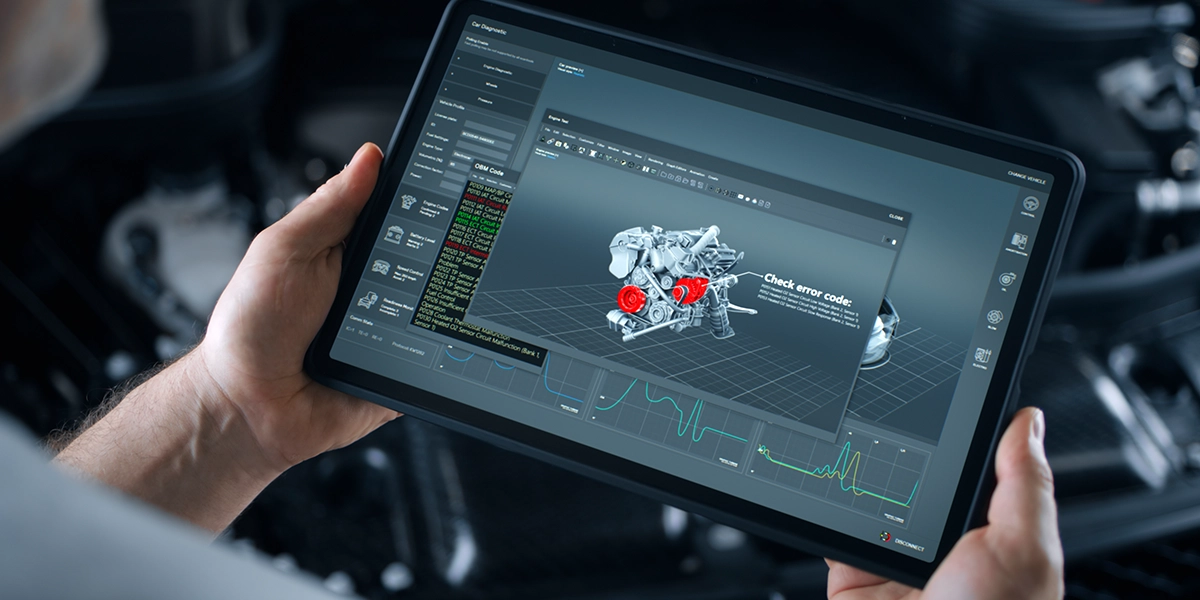
Modern products are packed with sensors, fault codes, and digital signals.
“These products will light up like a Christmas tree in terms of diagnostic trouble codes. All the lights are blinking, essentially,” Vanbeveren says.
The irony is that companies now have more data than ever but often less clarity. A screen full of alerts won’t tell you what actually failed, what to do about it, or if you need a technician.
That’s where knowledge-driven field service changes everything.
The goal is no longer data collection, but data translation. This translation turns raw data into actionable guidance for both technicians and end users.
“Sometimes the issue is fairly simple, sometimes it isn’t. Either way, it’s important we provide that knowledge and ensure that it actually means something.”
With the right information at the right time, many “breakdowns” become self-service fixes. Others become remote repairs. Only the most complex issues actually warrant a truck roll.
Each avoided visit is not just a cost save. In fact, it’s a new margin.
Field Service as a Profit Center
The real breakthrough happens when companies stop treating service information as disposable and start treating it as an asset.
“The most important thing is putting information in a database that’s useful for other technicians,” says Vanbeveren. “So, they can learn from mistakes that were made in the field.”
And providing that experience extends far beyond simply storing static user manuals. For Vanbeveren, it’s about capturing real-world repair history at the asset level. He says, “Asset based, serial number specific, VIN specific, that’s even better, because then you have a history of what happened to that vehicle.
“When every repair, fault and resolution is tied to a specific machine, patterns emerge. Certain failures recur. Certain fixes work better than others. Certain parts fail prematurely.”
Over time, that knowledge becomes a competitive advantage, allowing companies to:
- Predict failures before they happen
- Guide technicians to the most likely root cause
- Recommend the correct fix the first time
- Reduce unnecessary parts and labor
Once product data systems are unified and integrated, an additional layer of options emerge, options that begin to generate revenue on their own. An electronic parts catalog tied to a product’s original bill of materials does not only reduce the cost of maintaining that same catalog, it also reduces ordering friction and, by extension, helps an operation sell more spare parts. A service information portal with role-based permissions makes it easier to sell curated information bundles to third parties like insurance companies and independent repair shops.
A service operation employing all these measures first pays for itself, and then becomes a revenue stream in its own right.
It’s at precisely this juncture that cost control expands into value creation.
Turning Technicians into Multipliers
In practice, intelligent diagnostic systems become force multipliers.
Junior technicians benefit the most. “Junior technicians saw an 80% decrease in diagnosis time,” Vanbeveren says.
“That’s transformational. It means new hires become productive faster, require less supervision and make fewer costly mistakes. Even the most advanced master technicians will see a 20% decrease in diagnostic time.”
That 20% translates directly into more jobs per day, fewer repeat visits and better use of a shrinking expert talent pool.
Vanbeveren says the best guided diagnostics systems are those which recommend, but do not force, a set workflow. “We have to allow the lead technician the liberty to exercise his knowledge while also helping him become efficient.”
In optimal conditions, service bottlenecks vanish, and service becomes a growth engine.
How Profit Emerges from Better Service
So how does all this turn service into a profit center?
First, better diagnosis reduces waste. Fewer unnecessary parts, fewer truck rolls and fewer repeat visits directly improve margins.
Second, faster, more accurate service improves uptime for customers, making service contracts more valuable and more sellable.
Third, digital guidance enables new revenue streams via:
- Remote support subscriptions
- Self-service portals
- Predictive maintenance offerings
- Performance-based service agreements
When customers trust field service to keep their equipment running efficiently, they’re willing to pay for outcomes and not just repairs.
And finally, asset-based knowledge becomes proprietary IP. Over time, a service organization gains advanced product knowledge. That insight feeds back into engineering, product design and future offerings.
And the cost center becomes a flywheel.
The Future of Field Service Is Knowledge-Driven
Service is no longer about reacting to failures. Guiding decisions is now the order of the day.

Smart companies focus on making sure the right person, whether that’s a user, junior tech, or expert, gets the right information at the right moment, so they can fix the right problem with the right action.
As Vanbeveren puts it, “Identifying what the cause is and what steps will mediate that issue with or without spare parts, with or without technician intervention.”
With a certain level of efficiency, companies experience a tipping point where service starts to generate a revenue greater than its cost.
The secret is replacing guesswork with guidance.
To learn more about Field Service events, visit fieldserviceusa.com and fieldserviceeu.com.